
Development Journal 01
February 2026
Market Research
Researching the Gaming Market
Development Journal 01 explores the market research behind Axirune and how I narrowed the direction for my first solo-developed puzzle game.
Hansel Komal — HK Lab Studio
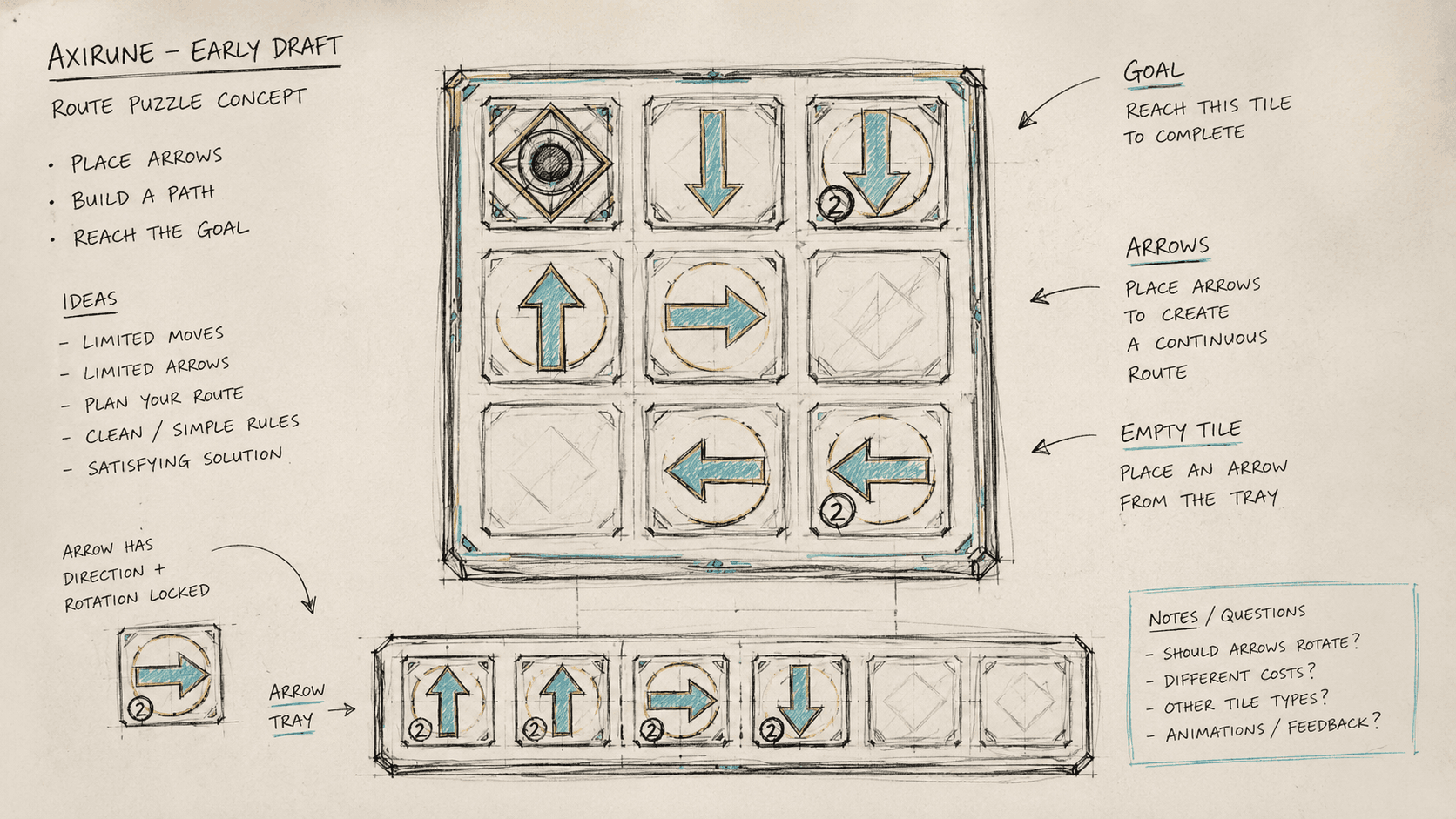
Before writing code or creating artwork, I needed to decide what kind of game I actually wanted to build.
Developing my first complete commercial game as a solo developer would mean handling almost every part of production myself — game design, programming, artwork, interface design, audio, testing and eventually marketing. Choosing a project with the right scope was therefore one of the first important decisions.Rather than immediately starting development, I spent time researching the gaming market and considering what type of game could realistically be created independently while still offering something worthwhile to players.
Finding the Right Scale
One of the first things I considered was scope.It is easy to imagine a large game filled with characters, environments, animation and complicated systems. Building all of that independently is another matter.For my first project, I wanted something focused enough that I could realistically complete it without requiring a development team.
Puzzle games immediately interested me because they can create meaningful gameplay without depending on enormous quantities of content.
A carefully designed puzzle system can take a relatively small number of rules and use them to create many different situations.That made the genre particularly interesting to me.
Looking Beyond a Single Playthrough
Another major part of my research was replayability.Many puzzle games are built around a fixed collection of levels. Once those puzzles have been completed, much of the experience has effectively been exhausted.I wanted to investigate whether I could take a different approach.The idea began forming around a game that would contain a deliberately designed campaign while also having systems capable of generating additional puzzle variations.
That meant replayability would not need to depend entirely on replaying the same levels.The underlying systems themselves could create new challenges.This eventually became one of the core ideas behind Axirune.
Simple Controls, Deeper Decisions
I also wanted the basic interaction to be immediately understandable.The player should not have to learn a complicated control scheme before being able to engage with the puzzle.The difficulty should come from the decision, not from performing the input.Directional arrows became particularly interesting for that reason.An arrow is almost universally understood: it points somewhere.
But placing directional pieces onto a structured board introduces a surprising amount of possibility. Routes can be planned. Pieces can be limited. Obstacles can interfere with a solution. Different arrow behaviours can change the way a path develops.I began thinking about a puzzle where the player would receive a selection of directional pieces and have to determine how those pieces should be positioned to create a successful route.
Axirune did not yet exist in its finished form, but the underlying idea was beginning to take shape.
Why 2D Made Sense
My research also strengthened the decision to build the project in 2D.Working in 2D would allow me to concentrate much more heavily on puzzle design, interface development and the underlying gameplay systems without simultaneously taking on the production requirements of a large 3D project.My background in graphic design also made this direction particularly appealing.I wanted the visual identity of the game to be something I could develop myself using vector artwork and interface design rather than depending heavily on pre-made external assets.That decision would eventually become an important part of Axirune's visual identity.
Designing for More Than One Device
Platform accessibility was another consideration from the beginning.I wanted the core interaction to work naturally using both mouse and touch input.
A board-based puzzle game was well suited to this approach because the player interacts directly with pieces and positions rather than relying on complex keyboard or controller combinations.Designing around that principle opened the possibility of supporting desktop computers, mobile devices and browser play without fundamentally changing the core game for every platform.
It was another piece of the concept beginning to fall into place.
A Game Built Around Systems
By the end of this research stage, the direction had become significantly clearer.
I wanted my first game to be:
easy to understand;
focused enough for solo development;
based primarily on logic rather than reflexes;
visually distinctive;
suitable for mouse and touch input;
expandable through additional mechanics;
capable of providing replayability beyond a fixed campaign.
Most importantly, I wanted it to be driven by systems.The same underlying mechanics should be capable of creating many different puzzle situations rather than requiring every experience to be individually scripted.That thinking would eventually lead to Axirune's directional-arrow mechanics, handcrafted campaign and procedural puzzle generator.But before I could build any of it, I had another important decision to make.
I needed to choose a game engine.

The criteria I used to narrow the direction of my first solo-developed project.
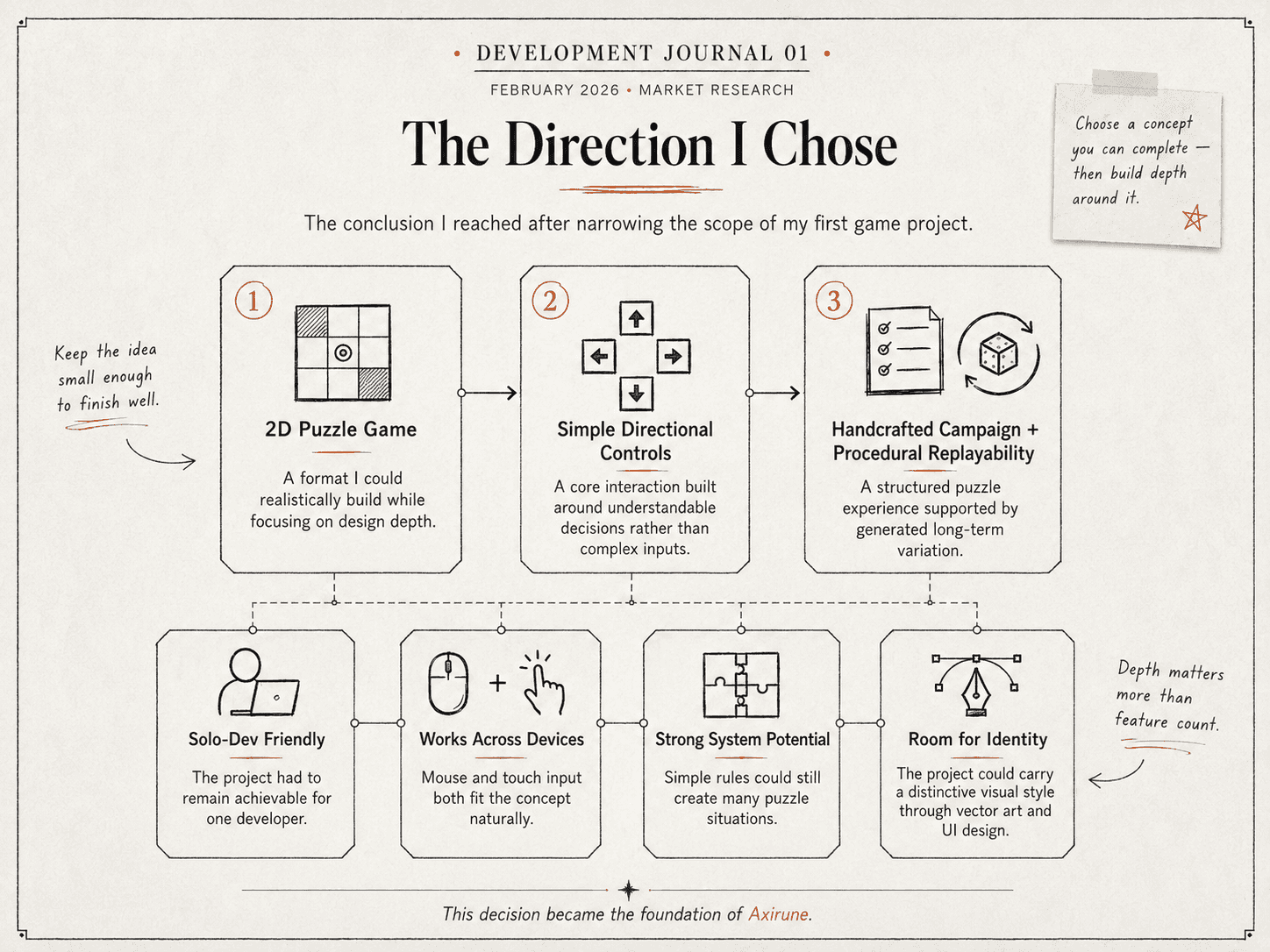
The direction that emerged from the research: a focused 2D puzzle game built around simple directional controls, handcrafted progression and procedural replayability.
DEVELOPMENT DECISION
Focus the first project on a 2D puzzle game with simple directional controls, mouse and touch support, a handcrafted campaign, and enough system depth to support procedural replayability.
WHAT I TOOK FROM THIS STAGE
The biggest lesson from this stage was that scope and depth had to be balanced. I did not need a large project; I needed a focused system that I could realistically finish, understand completely and expand over time.